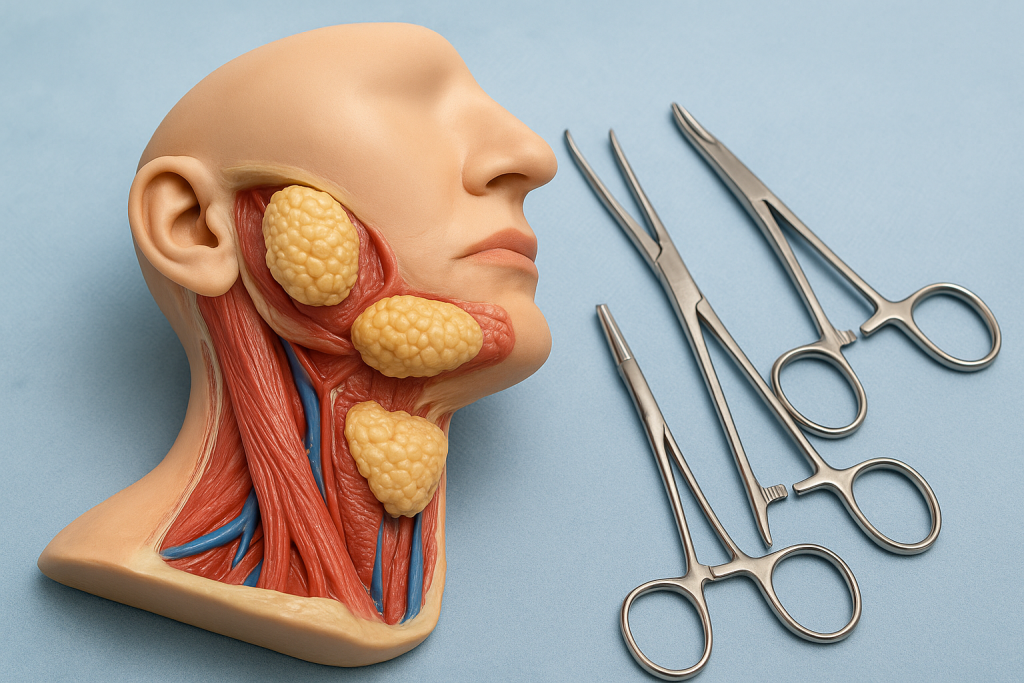
Surgical Removal of the Submandibular Gland, usually due to:
- Recurrent sialadenitis
- Sialolithiasis (salivary stones)
- Cystic or solid masses
- Suspicious lesions to rule out malignancy
The approach is cervical (below the jaw), with careful preservation of the facial and hypoglossal nerves
Surgical Removal of the Submandibular Gland, usually due to:
- Tumors (benign such as pleomorphic adenoma or Warthin's tumor)
- Less commonly for malignant neoplasms
- Chronic inflammatory conditions
The surgery is performed with dissection of the facial nerve (which crosses through the parotid), in order to preserve facial mobility
In a superficial parotidectomy, only the superficial lobe of the gland is removed, whereas in a total parotidectomy, the deep lobe is also removed.
Excision:
- Thyroglossal or dermoid cysts
- Lipomas of the submandibular or parotid space
- Intra-glandular cysts or lesions
Sialolithiasis:
The precise location is determined with preoperative ultrasound or MRI. Depending on the size and location of the stone, the following methods are applied:
- Conservative methods (massage, hydration, conservative management)
- Dilation of the excretory duct under local anesthesia
- Sialadenectomy (in cases of recurrence or large stones)
- Alternatively, endoscopic sialography is applied where expertise is available.
In cases of suspicious induration or increased size of the salivary gland or adjacent lymph nodes, the following may be required: – FNA (fine needle aspiration) – Surgical biopsy / excision. Histopathological examination determines further management or the need for oncological treatment."
The salivary glands (parotid, submandibular, sublingual, and small sporadic glands) are responsible for the production and secretion of saliva, which plays a key role in digestion, oral health, and lubrication of the oral cavity."
In some cases, issues such as stones (sialolithiasis), inflammations (sialadenitis), or tumors (usually benign) require surgical intervention. These procedures are performed with caution due to the proximity to important nerves, such as the facial nerve, and depend on the location, nature, and extent of the lesion.